Why Choose Construction Trash Containers for Your Project?
Construction projects create more than visible piles of wood, drywall, concrete, and packaging. They also create scheduling pressure, safety concerns, and disposal decisions that can affect the entire jobsite. The U.S. Environmental Protection Agency reported approximately 600 million tons of construction and demolition debris generated in 2018. That volume was more than twice the amount of municipal solid waste generated that year. These figures show why organized debris handling matters.
Construction trash containers provide a practical control point for daily cleanup. A properly sized roll-off container can sit near the framing area, reducing repeated trips across uneven ground. Workers can place broken gypsum board, timber offcuts, and damaged pallets into one planned location. Cleaner paths can support safer movement, although a container cannot replace proper site supervision. The Occupational Safety and Health Administration continues to identify housekeeping and material-handling practices as important jobsite safety concerns.
The right container also supports better waste separation. Concrete, metal, untreated wood, and mixed debris may require different handling routes. The EPA’s Sustainable Management of Construction and Demolition Materials guidance encourages reuse, recycling, and source separation where practical. That approach can reduce contamination and improve recovery opportunities. It is not always simple. Small projects may lack space, while busy sites may fill containers faster than expected. Still, selecting construction trash containers around project size, debris type, access, and pickup timing can make waste management more predictable. The choice deserves review, not guesswork.
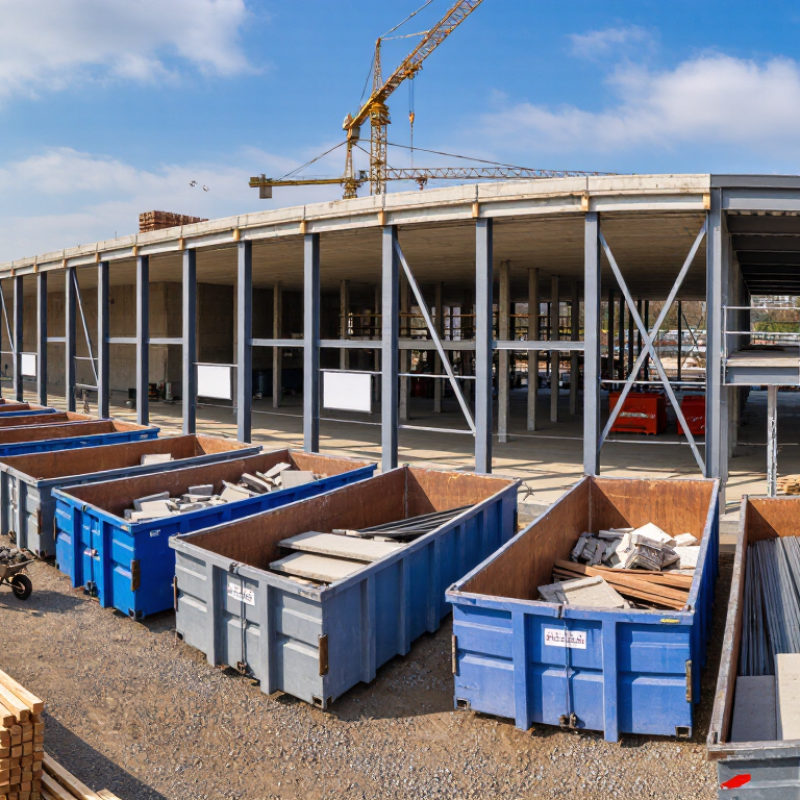
Construction Trash Containers Defined: Roll-Off, Front-Load, and Specialty Types
Construction trash containers are not interchangeable boxes.
They are site-planning tools with different capacities, loading methods, and access requirements.
The U.S. EPA’s 2018 Construction and Demolition Debris Generation Estimates report recorded about 600 million tons of debris.
That scale makes container selection more than a convenience.
Roll-off containers
Roll-off containers are open-top units delivered by truck and pulled away when full. They suit demolition, roofing, concrete, and large renovation projects. Their length requires clear driveway access and overhead clearance.
Front-load containers
Front-load containers are smaller, lidded units serviced on a regular schedule. They work better for compact sites, recurring waste, and projects producing packaging or light debris.
Access matters. A crowded site can make a suitable container unusable.
Specialty containers
Specialty containers support specific materials, such as concrete, soil, asphalt, or mixed recyclables. Separating heavy materials can reduce contamination and improve recovery.
The European Environment Agency has reported that construction and demolition waste represents roughly 37% of total waste generated in the European Union.
These figures show why sorting deserves attention, not just disposal capacity.
A practical mistake is ordering by visual volume alone. Dense concrete fills weight limits quickly, while bulky insulation fills space first.
also affect the decision.
Small is not simple.
Careful measurement still involves judgment, and early estimates may need revision after the first few workdays.
EPA’s 2018 Baseline: 600 Million Tons of U.S. C&D Debris
In 2018, the U.S. Environmental Protection Agency estimated 600 million tons of construction and demolition debris. That volume shows why jobsite waste deserves careful planning. It includes concrete, asphalt, wood, drywall, metal, and other materials. This is a national baseline, not an abstract statistic. On a busy site, one overflowing pile can quickly become mixed waste. That makes recovery harder and creates extra handling risks. Construction trash containers provide a defined holding point near active work areas.
Choosing the right container size requires practical judgment. A small unit may need frequent replacement, interrupting crews and deliveries. An oversized container can consume valuable space and encourage careless disposal. Site managers should review project phases, material types, access routes, and expected debris volume. Separate containers can improve sorting when space allows. Clear signs and routine inspections also help workers avoid contamination. Small details matter.
Not always. A container does not solve every waste problem. In practice, crews may still mix materials when schedules tighten or instructions seem unclear. A container can also hide poor sorting until pickup day. That weakness deserves attention. Reviewing collection timing, contamination, and leftover materials can reveal where the plan fails. EPA’s 600-million-ton estimate makes those reviews more meaningful. Each organized load represents a manageable response to a national construction waste challenge.
Why Choose Construction Trash Containers for Your Project?
The U.S. Environmental Protection Agency estimated that the United States generated approximately 600 million tons of construction and demolition debris in 2018. About 455.2 million tons were recovered for beneficial use, while approximately 143.5 million tons were disposed of in landfills. Properly sized construction trash containers can help separate, collect, and direct project debris toward recovery instead of disposal.
Source: U.S. EPA, 2018 Construction and Demolition Debris Generation and Management Baseline.
Container Sizing: Match Project Volume to a 10–40 Cubic-Yard Bin
Choosing the right construction trash container starts with estimating your project’s actual waste volume. A 10-cubic-yard bin suits small bathroom renovations, roofing repairs, or limited demolition. It can hold roughly three pickup-truck loads, depending on the material. Larger remodels may need a 20- or 30-cubic-yard container. Major cleanouts and structural work often require a 40-cubic-yard bin.
In my experience, volume estimates are easy to underestimate. Drywall stacks quickly, while broken cabinets create awkward gaps. Concrete and soil also become much heavier than expected. For dense materials, a smaller container may be safer and more practical. For bulky but lightweight debris, extra volume usually matters more than weight. Leave space below the fill line. Overfilled containers can create loading and transport problems.
Measure the work area before ordering. Count removed walls, flooring sections, roofing squares, or truckloads of debris. Add a modest margin for unexpected waste, but avoid choosing the largest bin automatically. A 40-cubic-yard container needs substantial clearance and may not fit beside a narrow driveway. Check access for delivery vehicles, overhead branches, and nearby structures. I once allowed too little turning space on a renovation site, and the placement slowed the crew. That mistake changed how I plan container access. A clear volume estimate, realistic material assessment, and site check make the 10–40 cubic-yard choice more reliable.
Waste Separation: EPA Reports 455 Million Tons of C&D Material Recovered
Why Choose Construction Trash Containers for Your Project?
Construction and demolition work creates mixed debris quickly. Concrete, wood, metal, drywall, and packaging may pile up beside a busy work area. Proper containers make separation easier and reduce unsafe walking routes. The EPA has reported that 455 million tons of construction and demolition material were recovered. That figure shows the value of organized waste handling. It also reminds project teams that recovery begins on site.
A container plan should match the material, project phase, and available space. Separate bins can keep clean metal away from broken drywall or treated wood. This improves sorting quality and may reduce disposal costs. Labeled containers help new workers make faster decisions. Clear access matters too. A blocked container becomes a daily problem. In practice, even good plans need adjustment when deliveries change or demolition expands unexpectedly.
Tips: Estimate debris before work begins. Leave room for safe loading. Use visible signs with simple examples. Check containers each day for contamination. Do not assume every material belongs in one bin. Some sites still mix waste despite careful instructions, and that weakness deserves honest review. Ask the hauling provider how recovered materials are weighed and documented. Reliable records support responsible decisions and show whether the project’s separation plan actually works.
Why Choose Construction Trash Containers for Your Project? — Waste Separation: EPA Reports 455 Million Tons of C&D Material Recovered
| Data Dimension | 2018 U.S. C&D Data | Calculation or Share | Why It Matters for Construction Trash Containers |
|---|---|---|---|
| Construction and demolition materials generated | 600 million short tons | National estimate for 2018 | A dedicated construction container provides a controlled collection point for bulky, heavy, and irregular project debris. |
| C&D materials recovered | 455 million short tons | Approximately 75.8% of the total generated | Separate containers can help keep recoverable materials cleaner and reduce contamination during collection. |
| C&D materials sent to landfills | 145 million short tons | Approximately 24.2% of the total generated | Source separation can support higher recovery and help limit the volume of project debris requiring disposal. |
| Recovered-to-generated ratio | 3.14 to 1 | 455 million recovered ÷ 145 million landfilled | The national recovery pattern demonstrates why organized debris handling and clearly designated containers are important. |
| Estimated material not recovered | About 1 in 4 tons | 145 million ÷ 600 million | Using separate containers for concrete, metal, wood, cardboard, and mixed debris can make sorting more practical on site. |
| Primary management objective | Prioritize recovery before disposal | Based on the difference between recovered and landfilled quantities | Construction containers support staged removal, safer work areas, better housekeeping, and more consistent waste separation. |
Safety Compliance: Apply OSHA’s 1926.252 Debris-Disposal Requirements
Why Choose Construction Trash Containers for Your Project?
Safety Compliance: Apply OSHA’s 1926.252 Debris-Disposal Requirements
Construction trash containers create a controlled destination for waste, but placement and use still require careful planning. OSHA 1926.252 requires debris removal methods that do not create hazards for workers nearby. When debris drops more than 20 feet outside a building, use a chute or an equivalent safe method. Inside floor openings, barricades and warning signs may also be required when chutes are not used.
Keep the container on stable, level ground away from entrances, ladders, and emergency paths. A spotter can guide delivery trucks and protect workers during pickup. The container should not block fire equipment or force crews to carry sharp debris across busy walkways. Remove scrap lumber, loose nails, packaging, and waste from active work areas as the project progresses. Small details matter.
Site leads should inspect the container area during each shift. Check for overflowing debris, unstable loads, exposed metal, and windblown materials. Do not place heavy concrete on top of lightweight waste. Separate awkward materials when practical, and follow the disposal instructions for the selected facility. We have seen clean sites become hazardous after one rushed loading cycle. That mistake is easy to repeat. A container supports compliance, but it cannot replace worker training, documented inspections, or sound judgment.
Related Posts
-
China Top 10 Construction Garbage Container Manufacturers
-
2026 Best Jobsite Dumpsters for Global Buyers?
-
Best Construction Garbage Containers to Buy for Your Project?
-
7 Tips for Choosing Construction Trash Containers?
-
How to Choose Construction Garbage Containers?
-
10 Best Construction Waste Containers for Global Buyers